Short-term conversational context within a session.
ENTERPRISE AI MEMORY · AGENT MEMORY · HYBRID RECALL
ESSCON Hybrid Memory Fabric
INDEPENDENT TECHNICAL FOUNDATION / ENTERPRISE INTEGRATIONModel-independent memory infrastructure for AI agents
Model-independent memory infrastructure for AI agents and multi-agent systems with separate knowledge spaces, Shared Project Memory, Hybrid Recall and self-hostable operating models.
ENTERPRISE AI MEMORY · MODEL INDEPENDENT
The AI can change. The enterprise memory remains.
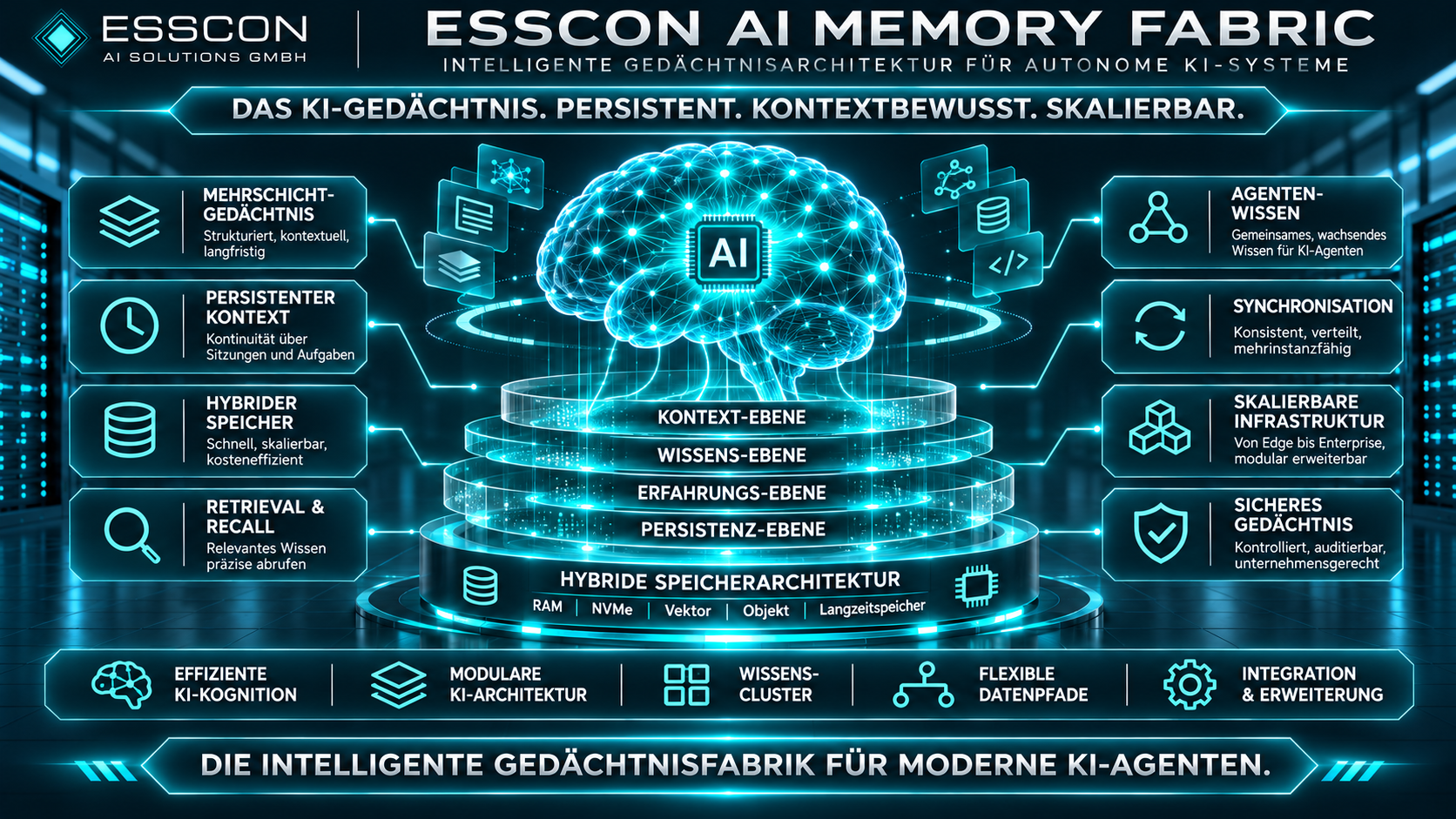
The ESSCON Hybrid Memory Fabric is an independent memory infrastructure between AI models, agents, applications, and persistent enterprise knowledge.
It gives individual agents their own long-term memory, provides shared project knowledge, and assembles the right context for each task. The long-term knowledge remains separate from the AI model being used.
WHAT IS IT?
Persistent AI memory outside the model.
A language model processes the current task. The Memory Fabric, by contrast, keeps knowledge available across sessions, model changes and agent changes. It manages who owns which knowledge, what can be shared, how current a piece of information is, and which memories are relevant to the next task.
Documents and knowledge sources are retrieved to match a query.
Agent identity, project knowledge, temporal context, experience, recall and long-term knowledge states are managed as dedicated infrastructure.
WHY IS IT NEEDED?
Without memory, an AI starts over again and again.
A new model does not have to mean rebuilding years of corporate knowledge from scratch.
Historical information does not have to be fully reloaded into the context window for every query.
Specialized agents can retain their own knowledge while still using shared project knowledge that has been made available to them.
Projects, facilities, customer cases and research run over weeks, months or years – memory can bridge this period.
ARCHITECTURAL PRINCIPLE
Knowledge becomes dedicated infrastructure.
Cloud model, local AI or an enterprise-owned agent: the active AI can change. Long-term knowledge remains in a separate memory layer and can continue to be used by new models.
WHAT CAN THE FABRIC DO?
Eight functions for long-term AI work.
The Fabric combines individual agent memory, shared project knowledge, targeted recall, temporal context, experience and traceable knowledge development.
01
Agent Memory
Dedicated long-term spaces for individual AI identities. An engineering agent may possess different knowledge from a communication, analysis, or support agent.
02
Shared Project Memory
Shared project and company knowledge is available to multiple agents without mixing their private knowledge spaces.
03
Hybrid Recall
The Fabric does not simply seek as much information as possible. It assembles the context relevant to the current task from multiple memory areas.
04
Temporal Memory
Knowledge is given a temporal reference. Past decisions, current states, and information that remains historically relevant remain distinguishable.
05
Experience Memory
Experiences, results, and proven approaches can be captured, evaluated, and later deliberately transferred into persistent knowledge.
06
Provenance & Audit
The origin, development, and use of stored information can be linked to its context and technically traced.
07
Person & Entity Context
People, systems, facilities, projects, and other entities can be consistently linked to their relevant knowledge context.
08
Controlled Learning
New information passes through defined steps before becoming part of the company’s long-term knowledge.
HOW AN AGENT WORKS WITH IT
From the task to the right memory.
An agent does not simply receive the complete corporate archive. For each task, the Fabric assembles a limited working context and keeps the result separate from long-term knowledge.
The Fabric recognizes which agent, project, and work context are involved.
Relevant memories from Agent Memory, Project Memory, and time-based knowledge are selected.
Only the relevant excerpt is passed to the active AI model.
The agent works with the current task plus long-term context.
An outcome, decision, or new observation can be captured as an experience.
Qualified knowledge can subsequently be permanently transferred to the appropriate memory area.
Individual memories for every AI role.
An engineering agent needs different knowledge from a communications, analytics or commercial agent. Separate memory areas keep these contexts clearly distinct.
PRIVATE AGENT MEMORYIDENTITY BOUNDARIESROLE CONTEXT
Shared knowledge where it is needed.
Project decisions, technical standards, approved processes and current work status can be made available to multiple agents.
PROJECT KNOWLEDGECONTROLLED SHARINGTEAM CONTEXT
HYBRID RECALL
Relevant context instead of maximum context.
Very large context windows only partially solve the memory problem. The Fabric selects precisely the portion required for the current task from the available knowledge spaces.
Less repeated data transfer. Less context load. More usable long-term knowledge.AGENT MEMORYPROJECT MEMORYTEMPORAL CONTEXTHYBRID RECALLWORKING CONTEXT
REMEMBER & LEARN
Experience only becomes long-term knowledge after review.
A conversation, a tool result or an observation can be captured as an experience or knowledge candidate. Only defined review and consolidation steps turn it into lasting, structured knowledge.
EXPERIENCECANDIDATEREVIEWCONSOLIDATIONLONG-TERM KNOWLEDGE
WHERE CAN IT BE USED?
Memory for AI systems that work over the long term.
The architecture is industry-agnostic. What matters is whether an agent is intended to retain knowledge over time, reuse experience, or share a common project context with other agents.
Internal assistants retain decisions, work status, role-specific knowledge, and relevant company contexts across sessions.
Technical agents can reuse previous analyses, implementation decisions, failure patterns, tests, and proven solution approaches.
Plant conditions, technical events, maintenance context, and previous investigations can be brought together over longer periods.
Experiments, hypotheses, datasets, analyses, and previous results remain addressable throughout long research cycles.
An agent can take prior history, resolved cases, product context, and relevant customer information into account across multiple interactions.
Project knowledge is not merely stored as a collection of documents; it can be made available again in an agent-specific, time-based, and contextual manner.
Long-term case, process, and professional contexts can be maintained in separate, clearly assigned knowledge spaces.
Long-term information contexts can be provided separately, with temporal references and traceability, where the specific deployment context allows for this.
Autonomous systems can use experience, task histories, environmental knowledge, and shared project information over longer periods of operation.
Multiple specialized agents receive their own memories and share only the knowledge that is actually needed jointly.
SELF-HOSTED · ON-PREMISE · PRIVATE CLOUD
The memory remains within the selected enterprise architecture.
The Memory Fabric can be operated in the company’s own data center, on dedicated enterprise servers, in a private cloud, or within existing AI infrastructure. This keeps the long-term knowledge base within the designated technical environment.
INTEGRATION INTO EXISTING SYSTEMS
APPLICATIONAI AGENTHYBRID MEMORY FABRICENTERPRISE KNOWLEDGE
Existing AI solutions can be connected via defined interfaces. The application remains in place; ESSCON adds the long-term memory layer.
MODEL-INDEPENDENT
One memory for different generations of AI.
Today, an agent may work with a cloud model, tomorrow with another provider, and later partly locally. As long as the interface remains in place, the same long-term enterprise memory can continue to be used.
CLOUD MODELLOCAL MODELENTERPRISE AGENTFUTURE MODELONE MEMORY LAYER
TECHNOLOGY CLASS
Agent memory is becoming an infrastructure issue.
Long-term memory systems for agents are developing into a technology class of their own: storage alone is not enough. Scope, recall, temporal context, consolidation, access, and the transition from experience to lasting knowledge will become decisive. The ESSCON Hybrid Memory Fabric brings these capabilities together in an independent enterprise layer.
TECHNICAL MATURITY
Independent foundation for customer integrations.
The architecture originated from a practically deployed multi-agent memory system and was subsequently isolated and validated as an independent technical unit.
Individual knowledge spaces for different AI identities.
Shared project knowledge with controlled handovers.
Targeted context construction from multiple memory layers.
Time-based states and changes remain distinguishable.
Persistent storage, persistence across restarts, as well as backup and recovery.
Can be used as a separate memory layer for existing or new AI systems.
ESSCON HYBRID MEMORY FABRIC
Long-term memory as dedicated AI infrastructure.
For individual assistants, specialized agents, or complete multi-agent systems. Model-independent, self-hostable, and individually integrable into existing enterprise architectures.
Request an initial technical assessmentREGULATORY & STANDARDS READY
LONG-TERM MEMORY NEEDS DATA SOVEREIGNTY AND CLEAR BOUNDARIES.
A memory layer does more than store content: it determines which knowledge is available to which agent or project. Identity, scope, provenance, temporal context and controlled sharing are therefore treated as a dedicated governance layer.
The operating model and data classification determine where memory is hosted and which review, access and deletion rules apply.
EU REGULATORY FRAMEWORK
STANDARDS & ASSURANCE
DATA SOVEREIGNTY & MEMORY
COMPLIANCE BY ARCHITECTURETRACEABILITYAUDITABILITYTECHNICAL EVIDENCE