
Fixed dataset
Analyses are tied to a defined dataset version and the associated reference sources.
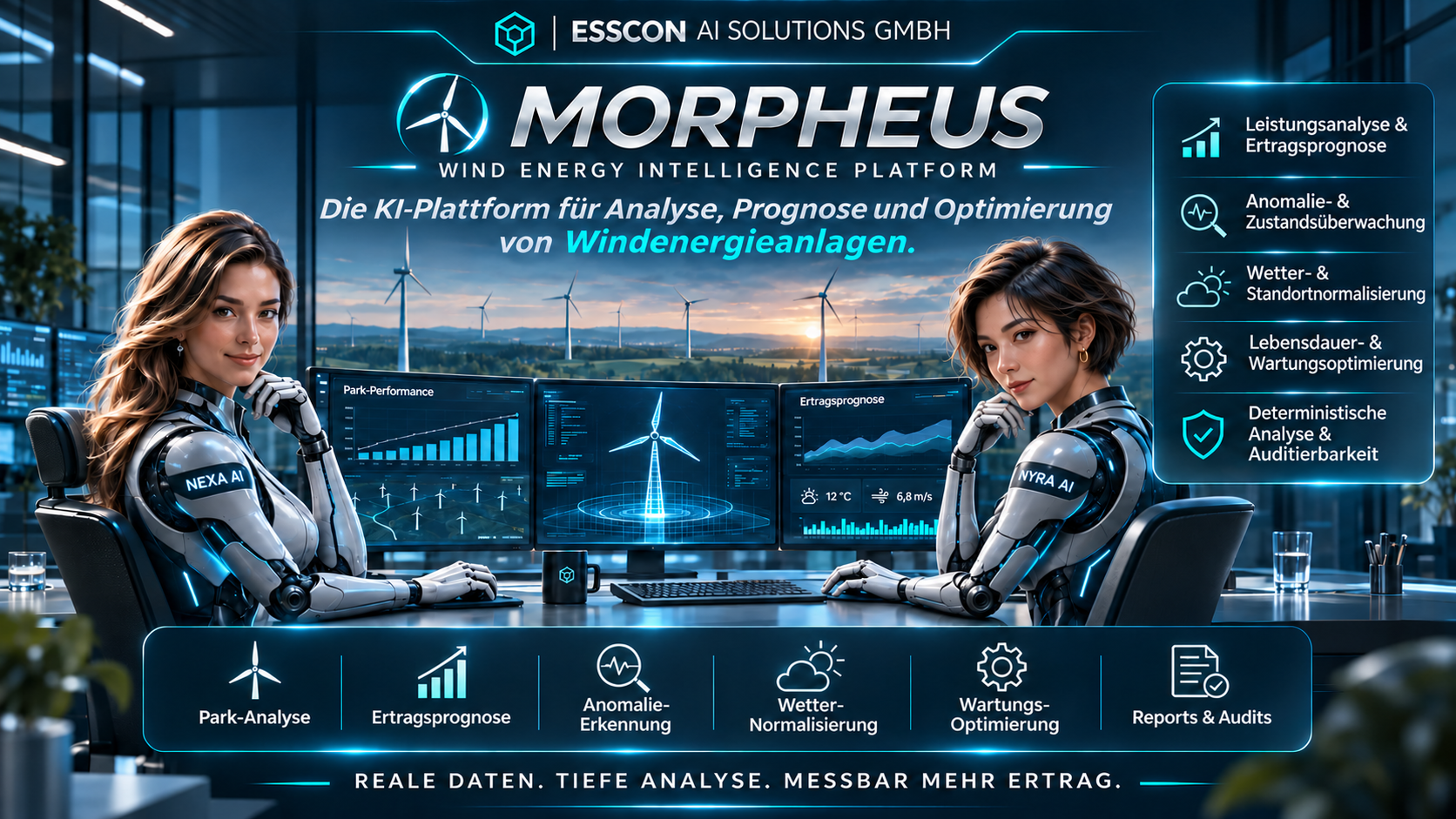
ESSCON AI SOLUTIONS GMBH develops deterministic analytical methods for large technical datasets. Morpheus is the extensible platform behind them. Wind farm analyses are already available today.
Large technical datasets are rarely uniform. ESSCON develops deterministic analysis methods that combine raw data, operating states, events, reference data and domain logic to produce robust technical findings.
Morpheus is the platform for this. Each analysis area has its own domain logic, defined data flows and reproducible testing procedures – from wind farms to other technical asset classes.
Morpheus keeps the dataset, execution, checks and report clearly separate. This makes it possible to identify which data was used, which modules were run and what an outcome is based on.
Analyses are tied to a defined dataset version and the associated reference sources.
Approved modules work with defined inputs and specified execution paths. This makes results reproducible.
Execution, verification steps and relevant results are documented with technical evidence.
Data maturity, analysis, execution and reporting are approved separately.
Factual anchors, comparison values and statement boundaries make deviations visible and verifiable.
An identical data and analysis state leads to the same technical result via the same verification path.
Auditable from raw data to the technical finding.
Operators, investors and technical reviewers see the result, data basis and verification path together.
Wind logic is not transferred to other asset classes. New areas receive their own terminology, modules, data requirements, maturity checks and report statements.
Wind is currently in production. Additional asset classes are prepared and will be expanded step by step from 2027 onward. The respective status is shown as available oder vorbereitet gekennzeichnet.
Morpheus is in production today for wind energy. Wind farm, manufacturer, event, weather and reference data are brought together in a shared technical analysis context.
A dedicated analysis area for solar parks is prepared, with dedicated data profiles, modules, maturity checks and a suitable reporting logic.
The prepared storage area combines technical condition data with cycles, dispatch planning, efficiency, degradation and the economic context.
A dedicated analysis area is planned for pipelines. Operations, integrity, pressure, flow and inspection data will have a separate data and validation profile.
The planned biogas area combines material flows, gas yield, BHKW operation, heat and electricity balances, and technical availability.
Grid, metering and portfolio analyses form the overarching level for the technical comparison of multiple plants, metering points and portfolios.
Terms such as asset, measurement value, condition and result are defined with technical precision for each area.
Each area has its own analysis family and the associated modules.
Raw data, metadata and reference sources are defined for each asset class.
External data, approvals and evidence are defined before the analysis.
Maturity criteria show whether a dataset is sufficient for the intended analysis.
The report and its limitations are based on the actual qualified scope of analysis.
WindEurope describes the diversity of manufacturers and models, and the harmonisation of their respective databases, as a key prerequisite for interoperability. The European Commission also identifies a lack of data interoperability as a barrier to data-driven energy and AI applications.
Different manufacturer formats are transferred into a common technical analysis context. The evaluation then uses the respective specialist logic.
Deterministic wind farm analyses are available today. The current Morpheus wind logic comprises 21 registered analysis and validation modules for data quality, performance, availability, anomalies, early indicators, wake, yaw, condition monitoring and loss attribution.
Curtailment analysis (Curtailment)
Loss attribution
Dataset profile
SCADA quality check · Basic
Availability check · Basic
Top-/Bottom scoring
Outlier overview
SCADA quality check
Power curve
Power deviation
Fleet comparison
Power drift
Availability
Metering/Grid Reconciliation
Weather normalization
SCADA anomalies
Early fault indicators
Condition Monitoring
Wake indicator (Wake)
Yaw misalignment (Yaw)
Power curve per asset
The Penmanshiel report demonstrates Morpheus under real-world data conditions. Operational, status, weather, loss and reference signals are brought together there into a prioritised technical basis for decision-making.
Weather, event, status and measurement data, as well as condition references, were integrated into a common analysis context.
Factual anchors, rankings, tables and signal families lead to specific review paths and technical priorities for the operator.
84 pages · 8.5 MB · technical operator report with documented limitations on its statements and a complete Morpheus evaluation.
From data intake to the customer report, every step has a defined status. The analysis and approval status therefore remain traceable at all times.
Morpheus starts with data intake and ends with the approved customer report. In between are dataset validation, module planning, execution and technical evidence.
Wind farm and fleet analysis, technical loss and performance assessment, data quality checks, prioritization and operator reconciliation.
Request a wind farm analysisSolar, battery storage, pipelines and biogas will be developed as independent specialist areas until their respective products are released.
Before an on-site technical inspection, Morpheus provides a reliable prioritization. Causal conclusions remain tied to evidence; the next inspection path is structured independently of the manufacturer.
For energy and industrial assets, governance starts with data sources, measurement chains, access rights and a clear separation between analysis and technical intervention. OT security, traceability and approvals are therefore considered in the system design.
The applicable regulatory and normative requirements depend on asset class, operator role, data path and operating environment. These conditions are defined and documented before integration.