REMOTE FABRIC · AI EXECUTION · PHYSICAL AI
NEXA AI Remote Control
NETWORKED AI EXECUTION INFRASTRUCTUREAI execution & remote infrastructure
Shared control and execution infrastructure for computers, servers, applications, AI agents and networked technical systems.
REMOTE FABRIC · AI EXECUTION · PHYSICAL AI
When artificial intelligence can act with authorization.
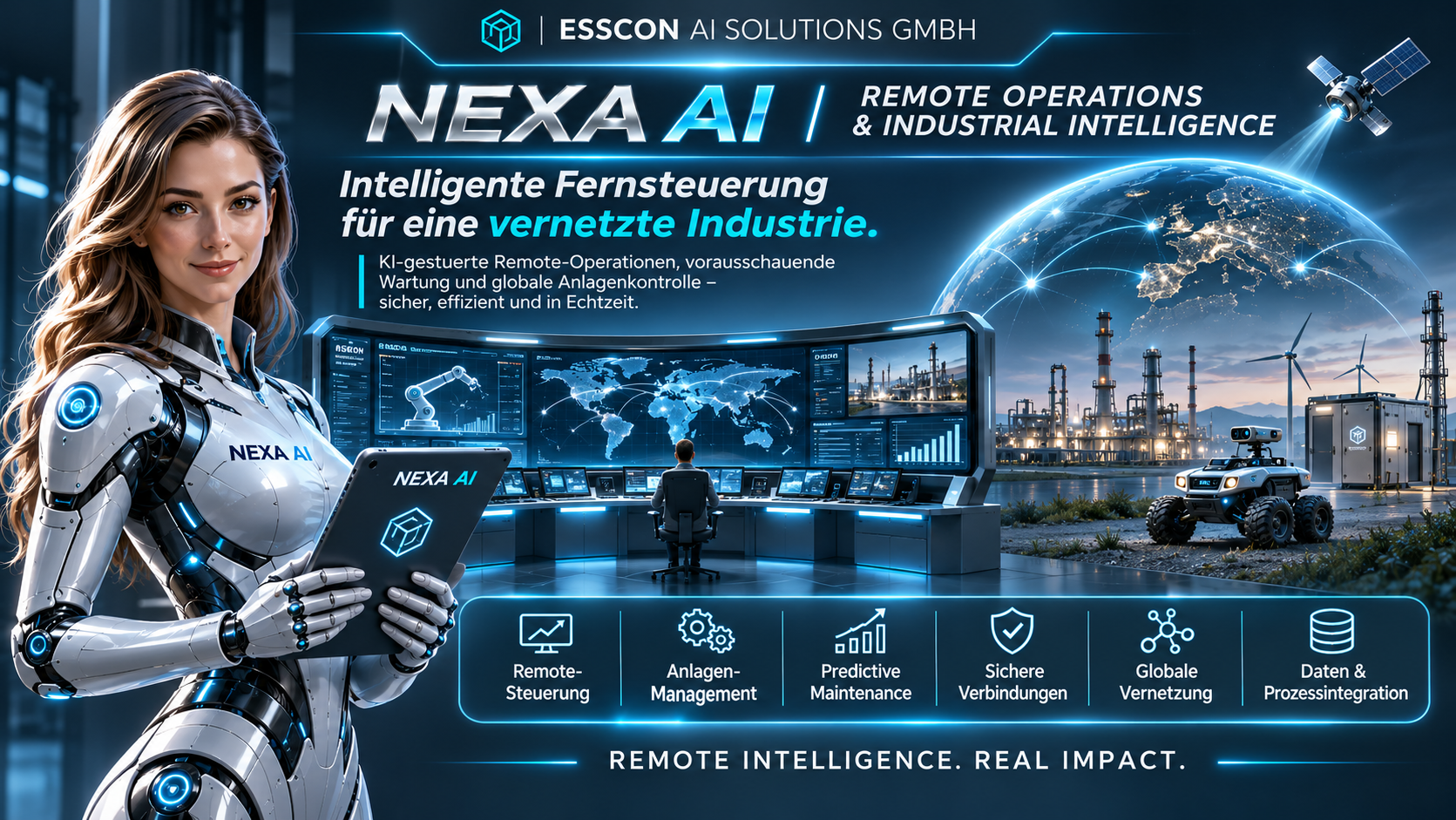
NEXA AI Remote Control connects computers, servers, applications, AI agents and technical infrastructures within a shared intelligent control environment.
Isolated devices and individual software solutions become an interconnected overall system in which humans and AI systems can coordinate tasks, capture technical states and execute approved actions in a controlled manner.
NEXA REMOTE FABRIC
A shared execution infrastructure for the digital and physical worlds.
Secure technical accessibility, unique device identities and appropriate authorization connect local systems, data centers, edge devices and hybrid cloud infrastructures within the same fabric.
CENTRAL CONTROL PLATFORM
From device management to AI execution.
NEXA Remote combines traditional remote functions, automation tasks and AI agents in a shared technical environment.
MULTI-AI TECHNOLOGY
Individual assistants become a coordinated digital team.
Multiple specialized agents can assume different roles within a shared workflow: capture status, investigate causes, prepare measures, execute authorized actions and document results.
01Capture state
Authorized agents read technical states, available resources and defined system information.
02Analyze
Specialized AI systems examine anomalies, causes and correlations within their respective roles.
03Prepare task
Analysis results are used to create concrete, verifiable work tasks rather than mere text suggestions.
04Execute in a controlled manner
Only approved tools and technical actions are executed within the assigned permissions.
05Document result
Execution, state and outcome are recorded in a traceable manner using logs, verification values and status acknowledgements.
BROWSER · DESKTOP · FASTTEXT
Continue using existing software — while still operating it through AI.
NEXA specifically identifies windows, browser tabs and input fields. The developed FastText technology enables complete texts to be transmitted directly to a uniquely bound input field via an encrypted transmission path.
This makes it possible to automate existing applications and continue using existing software landscapes. Traditional user interfaces become a controlled execution layer for authorized AI agents.
GLOBAL INFRASTRUCTURE
Connected regardless of location.
Office, production hall, data center, mobile site or international facility: the Remote Fabric is designed for geographically distributed environments.
INTERNETFIBER OPTICSMOBILE NETWORKSATELLITEEDGEHYBRID
SECURITY · CONTROL · SOVEREIGNTY
AI receives the tools. Humans define the scope of action.
Remote execution is only professionally viable when identity, permissions, traceability and recovery are taken just as seriously as the function itself.
Controlled device identities
Registered devices are assigned to authorized environments and defined communication paths.
Encrypted communication
Remote Fabric and FastText use secured transmission paths for technical communication and inputs.
Owner approvals
Access can be granted or revoked. Local approval and STOP mechanisms remain decisive.
Traceable execution
Tasks, technical states and results can be documented through logs, verification values and acknowledgements.
Controlled recovery
Restarts, recovery and rollback are monitored and documented rather than automated blindly.
Digital sovereignty
Own servers, local AI systems and self-operated infrastructure can remain part of the architecture.
PHYSICAL AI
From digital execution to connected machines and robots.
NEXA Remote Fabric is designed as an overarching layer for communication, identities, jobs, technical monitoring and coordinated collaboration. Suitable interfaces can be used to connect robotics, machines, sensor platforms, edge computers and mobile systems.
Safety-critical motion and machine functions remain with suitable local controls, protective mechanisms and, where required, the necessary approvals.
APPLICATION AREAS
Infrastructure for almost every connected industry.
The platform is designed for cross-industry use: wherever digital information is processed, devices are managed or technical processes are coordinated.
Industry 4.0
Production lines, machinery, sensors, predictive maintenance, robotics, IoT and digital twins.
Humanoid Robotics & Physical AI
Coordination, status, diagnostics, knowledge access and task allocation for robots and mobile systems.
Autonomous Mobility & Transport
Fleets, technical vehicle states, control centers, logistics, rail, port and airport systems.
Smart Cities
Municipal IT, energy, buildings, mobility, sensors, lighting, parking and environmental monitoring.
Energy & Renewables
Solar, wind, storage, charging infrastructure, SCADA, microgrids, remote maintenance and technical analyses.
Data Centers & IT
Server monitoring, diagnostics, software maintenance, provisioning, recovery and hybrid infrastructure.
Telecommunications & Satellite
Mobile communications/edge sites, network diagnostics, satellite internet and remote infrastructure.
Logistics & Supply Chains
Warehouse technology, vehicle fleets, conveyor systems, inventory management and technical operating processes.
Agriculture
Greenhouses, irrigation, agricultural sensors, livestock facilities, energy optimization and autonomous agricultural machinery.
Healthcare
Device inventory, technical states, laboratory IT, infrastructure diagnostics and maintenance coordination.
Research & Science
Distributed computing resources, laboratory computers, analyses, experimental documentation and research agents.
Construction & Buildings
Building services, energy, climate, lighting, construction-site communications and remote service.
Maritime & Offshore
Ships, offshore facilities, port operations, energy projects and remote technical stations.
Aerospace
Ground stations, test stands, maintenance, research facilities, drones and mission support.
Public Administration
Specialist applications, workstations, document processes, remote service and controlled automation.
Finance & Services
Distributed IT, specialist software, business operations and specialized AI assistants.
Retail & E-Commerce
Branch/store and point-of-sale systems, online platforms, back office, merchandise management, customer service and marketing.
Media & Communications
Production systems, media servers, content workflows, rendering/processing systems and publishing.
Education & Training
Digital learning environments, training computers, technical laboratories and AI-supported learning infrastructure.
Security & Crisis Management
Alarm aggregation, situation overviews, diagnostics and digital support in authorized environments.
SCALABLE ARCHITECTURE
From a single workstation to international infrastructure.
Remote support, routine tasks and AI-supported IT services.
Multiple locations, servers, specialist applications and automated processes.
Distributed plant operations, manufacturing integration and technical operational analyses.
Cross-site infrastructure with graduated access permissions.
Shared execution environment for agents, computing resources and research infrastructure.
Edge devices, robotics, machine platforms and suitable industrial interfaces.
WHY NEXA AI REMOTE CONTROL?
More than remote access.
CENTRALIZED CONTROLINTELLIGENT AUTOMATIONLOCATION INDEPENDENCEFLEXIBLE INTEGRATIONTRANSPARENT EXECUTIONDIGITAL SOVEREIGNTYSCALABILITYTECHNOLOGICAL OPENNESS
ESSCON AI SOLUTIONS GMBH · NEXA AI REMOTE CONTROL
WHERE INTELLIGENCE MEETS CONTROL.Human intelligence. Artificial intelligence. Machine intelligence.
As components of a shared technical environment.
REGULATORY & STANDARDS READY
TECHNICAL EXECUTION NEEDS DEFINED BOUNDARIES.
Once AI can operate real computers, devices or technical systems, identity, permissions, approvals, logging and safe fallback paths become architectural requirements. Autonomy is therefore bounded per tool and process rather than granted globally.
Machine, OT and cybersecurity requirements may apply depending on the deployment. The permitted action space is defined technically and organisationally before integration.
EU REGULATORY FRAMEWORK
STANDARDS & ASSURANCE
REMOTE / OT / PHYSICAL AI
COMPLIANCE BY ARCHITECTURETRACEABILITYAUDITABILITYTECHNICAL EVIDENCE