
higher computing performance
In qualified internal CPU benchmark series compared with the respective defined reference computation for suitable workloads.
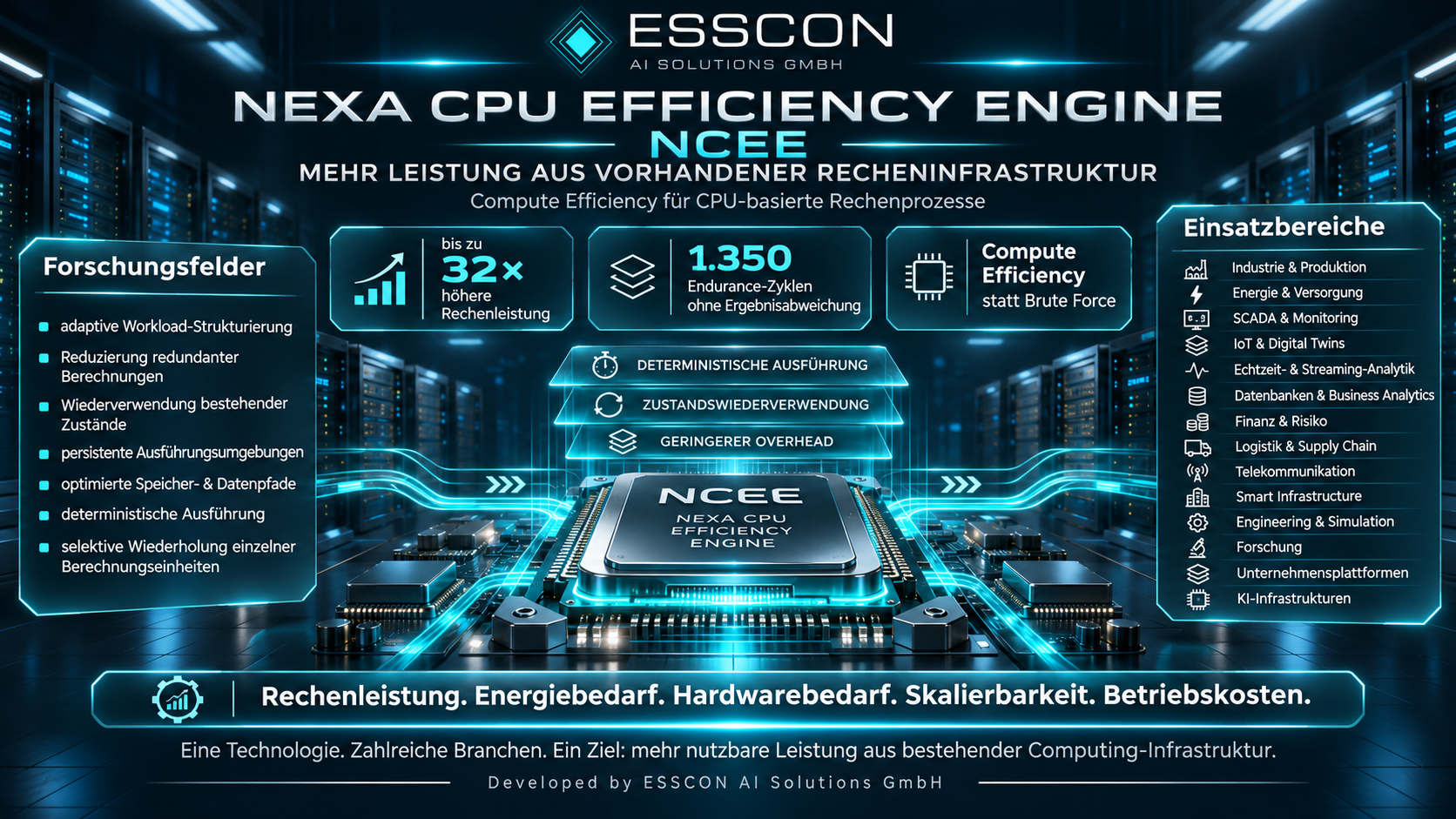
Proprietary CPU compute-efficiency technology for more efficient computing processes and more economical use of existing hardware performance.
The NEXA CPU EFFICIENCY ENGINE – NCEE is a proprietary compute-efficiency technology developed by ESSCON AI Solutions.
NCEE was developed to execute CPU-based computing processes more efficiently and make existing hardware performance more economical to use.
More usable performance from existing computing infrastructure.
Growing data volumes and increasingly complex digital systems are driving demand for computing power worldwide. NCEE extends conventional IT infrastructures with an additional layer of Compute Efficiency — from individual workstations and enterprise servers to industrial platforms, data centers and distributed computing infrastructures.
The figures apply to the defined internal benchmark and endurance test cases in each instance. The achievable performance increase depends on the workload, data structure and system architecture.
In qualified internal CPU benchmark series compared with the respective defined reference computation for suitable workloads.
Consecutive computation cycles without deviation in results from the reference.
NCEE optimizes CPU-based computing processes and is intended to enable more economical use of existing hardware performance.
The achievable performance increase depends on the respective workload, data structure and system architecture used.
NCEE is designed as a cross-industry Compute Efficiency technology for data- and compute-intensive applications.
In suitable application scenarios, higher Compute Efficiency can help make more intensive use of existing CPU resources, increase processing capacity and scale infrastructure more economically.
Existing CPU resources can be utilized more intensively for suitable workloads, increasing processing capacity.
Reducing the amount of computing required can lower the energy consumption of qualified processing segments.
Existing infrastructure can be used for longer and more economically before additional hardware is required.
Compute Efficiency creates an additional optimization layer between the application and existing computing infrastructure.
Making more usable performance available from existing systems can improve the economics of data- and compute-intensive processes.
NCEE can already be integrated into existing IT, server and compute infrastructures on a project-specific basis. Implementation is tailored to the respective system architecture, operating system, runtime environment and target-system requirements.
NCEE can already be integrated individually into existing IT, server and computing infrastructures.
Integration is based on the system architecture, operating system, existing runtime environment and the technical requirements of the target system.
NCEE is designed as an independent additional Compute Efficiency layer and can complement existing software and server environments.
Integration is carried out via controlled components and interfaces, while the proprietary technology core remains protected.
The architecture is intended in the long term for environments in which different operating systems, hardware generations and server roles are operated within a shared infrastructure. Additional platforms may be added in subsequent development stages.
For the next product generation, ESSCON is developing an AI-assisted deployment layer that goes beyond a conventional software installer. The objective is an automated pipeline that analyzes target systems, checks prerequisites, provides suitable runtime components, validates the installation and documents operational readiness.
The target environment is intended to be detected and technically classified automatically.
The operating system, runtime and technical prerequisites are intended to be checked before deployment.
The NCEE components suitable for the specific target system are intended to be deployed automatically.
The configuration, version status and integrity of the deployed components are intended to be checked in a controlled manner.
Future runtime and integration updates are intended to be managed on a system-specific basis and rolled out with traceability.
Following installation, operational readiness is to be checked and documented automatically.
Compute Efficiency as an Infrastructure Layer.
In the future, NCEE is also intended to be deployable in complex enterprise environments with minimal manual integration effort — with controlled provisioning, integrity checks, technical self-validation and the technology core remaining protected.
Within ESSCON's Compute Efficiency research, NCEE is continuously qualified on different hardware platforms and application classes. Performance figures are qualified on a workload-specific and platform-specific basis.
Optimized execution and defined reference computation are compared under controlled conditions.
Suitability and actual benefit are assessed for each data structure, application class and system architecture.
Accepted test series require the result parity defined for the respective workload in comparison with the reference.
The engine is tested through individual measurements as well as repeated and longer-running computation sequences.
NCEE is developed within ESSCON's Compute Efficiency research. The underlying methods and architectures are proprietary technological know-how.
The technology is designed for controlled integration and qualification; defined interfaces protect the internal technology core.
For compute and communication infrastructure, the main controls are identity, access rights, system hardening, operational continuity and traceable changes rather than generic AI policy alone. These controls are tied directly to technical operations.
Required standards and evidence depend on operating model, data class, customer environment and criticality. Integrations are scoped and documented accordingly.