AI & Cognitive Systems
Research into new architectures for specialized, interconnected and long-term context-capable AI systems.
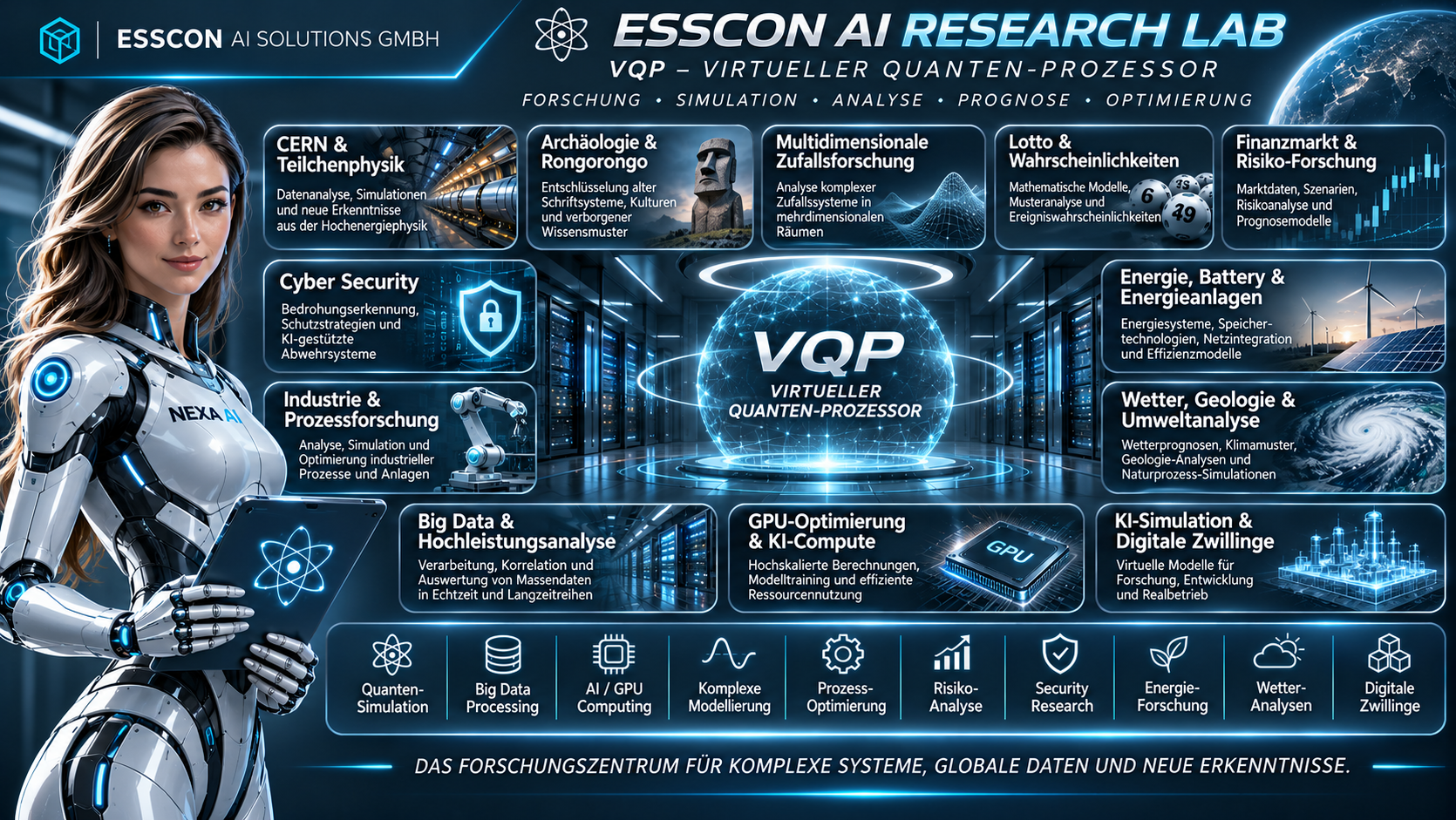
ESSCON research platform for complex systems, VQP, high-performance analysis and the evidence-based development of new AI, analytical and compute technologies.
The ESSCON AI Research Lab forms the protected research area for new AI, compute, analysis and system architectures. It investigates questions that go beyond conventional standard software and established solution approaches.
Some of this work will later feed into standalone ESSCON technologies and products. Research approaches, methods and internal architectures remain within the protected ESSCON development environment.
VQP is an internal research instrument for complex system and data spaces.
VQP – Virtual Quantum Processor – denotes a software-based experimental ESSCON research architecture for complex system and data spaces. Its internal operation and research geometry remain within the protected development environment.
The research programs have different levels of maturity. Publicly presented are subject areas and technological directions; internal solution approaches remain part of the protected research work.
Research into new architectures for specialized, interconnected and long-term context-capable AI systems.
Investigation of more efficient computing, data and execution architectures for demanding workloads.
New approaches for large, heterogeneous and time-dependent data spaces with many interdependencies.
Experimental analysis and simulation approaches for complex scientific questions.
Research approaches for technical processes, facilities, energy and infrastructure systems.
Research into robust, traceable and controllable digital systems.
ESSCON analysis procedures are designed so that the data source, processing, version, audit trail and result can be documented in a traceable manner. Given identical approved input and an identical analysis state, the same defined audit path reproducibly leads to the same result.
Results remain tied to the data, input states and defined sources used.
Relevant processing steps, versions, checks and results can be documented as a traceable chain of evidence.
Where a task can be solved deterministically, we rely on defined rules, reproducible processes and controlled comparison conditions.
Analysis, validation and operational use can be separated from one another through defined gates, roles and approval points.
References, cross-checks and technical validation serve to make deviations visible rather than conceal them.
A robust analytical process should remain repeatable under the same conditions and independently verifiable.
A robust analysis shows how it arrived at its result.
Particularly in technical, industrial, scientific and regulated environments, this traceability is a central element of our development philosophy.
Selected visualizations from our CERN research workspace show real CMS reference data, historical sensor geometry and reproducible comparative analyses.
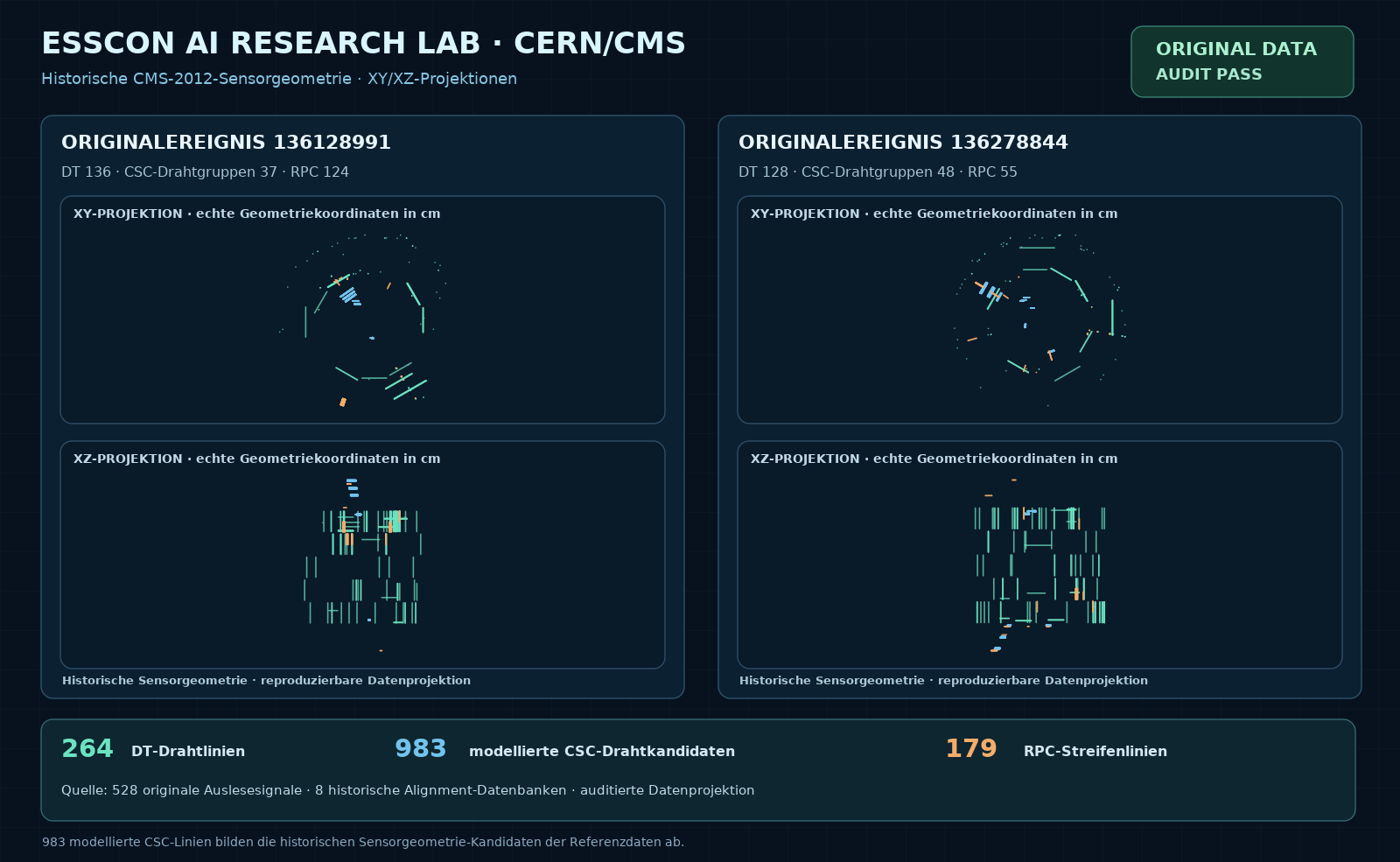
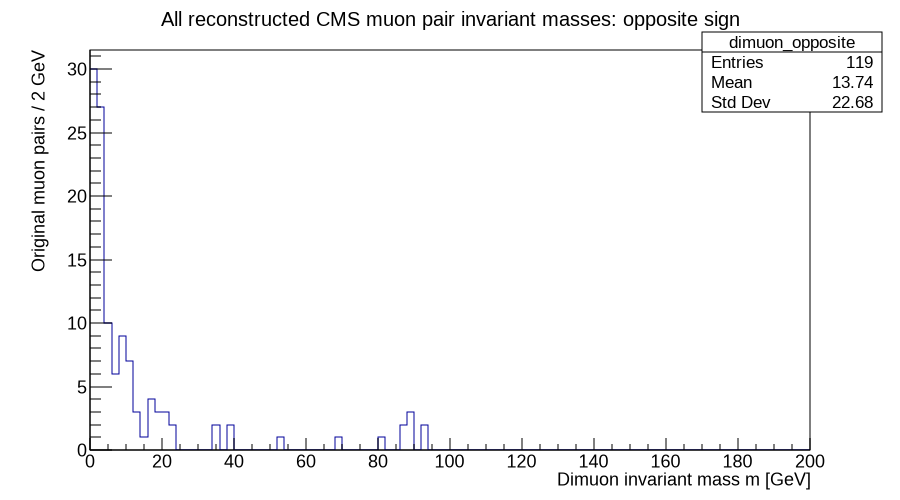
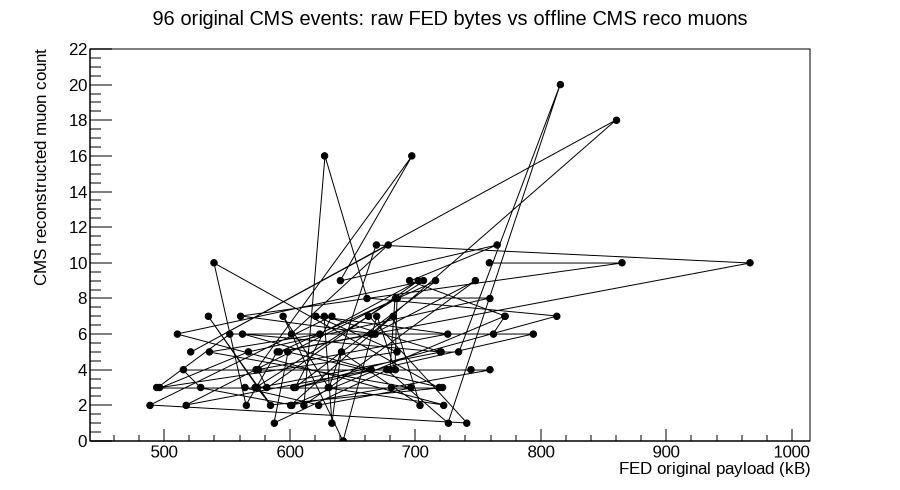
As part of its research program, ESSCON worked with original CMS Open Data datasets. We publicly show selected reference examples and result metrics; the internal VQP measurement and architecture methods remain protected.
In a defined CMS reference run, 24 certified events were fully reconstructed. This involved evaluating 99 muons and all 227 possible muon pairs without subsequent candidate selection, and checking them against an independent numerical reference.
A new 96-event holdout from CMS Run 194429 comprised 372 reconstructed muons and 767 complete muon pairs. The same research framework was then tested again on a second original CMS Run 194428 with 405 muons and 969 pairs.
For CMS Run 194315, a source-side analysis was defined and sealed before the subsequent offline physics reconstruction. Only then was the CMS reference reconstruction performed with 452 muons and 1,348 muon pairs. This kept the sequence of research and subsequent reference verification transparently separate.
The CERN work demonstrates data integrity, comparability, holdout behavior and reproducible research processes. Its scientific significance is transparently qualified and clearly distinguished from further particle physics research.
New approaches are investigated internally, technically evaluated and, where sufficiently robust, transferred into independent engineering or product programs. This creates a clear path from research to qualified technology.
Experiments and results are documented internally and checked against defined comparison conditions.
Methods, architectures and technical details remain within the protected ESSCON research environment.
Robust findings can be transferred into separate technology and development programs.
Research, validated technology and market-ready product follow clearly separate development stages.
The public research page makes technological expertise, research breadth and development capability visible. Technical detail documentation remains within the protected research environment.
Decisive methods, architectural principles, research models and implementation details remain confidential.
Research and analytics projects need clear separation between data state, assumptions, execution, comparison conditions and result limits. Provenance and technical evidence are therefore carried through the experimental and analytical path.
Additional requirements depend on data source, research field, partners and intended downstream use. Product or operational approval remains separate from exploratory findings.