higher compute performance
Measured in demanding, neutral AI and matrix validation workloads with confirmed result equivalence.
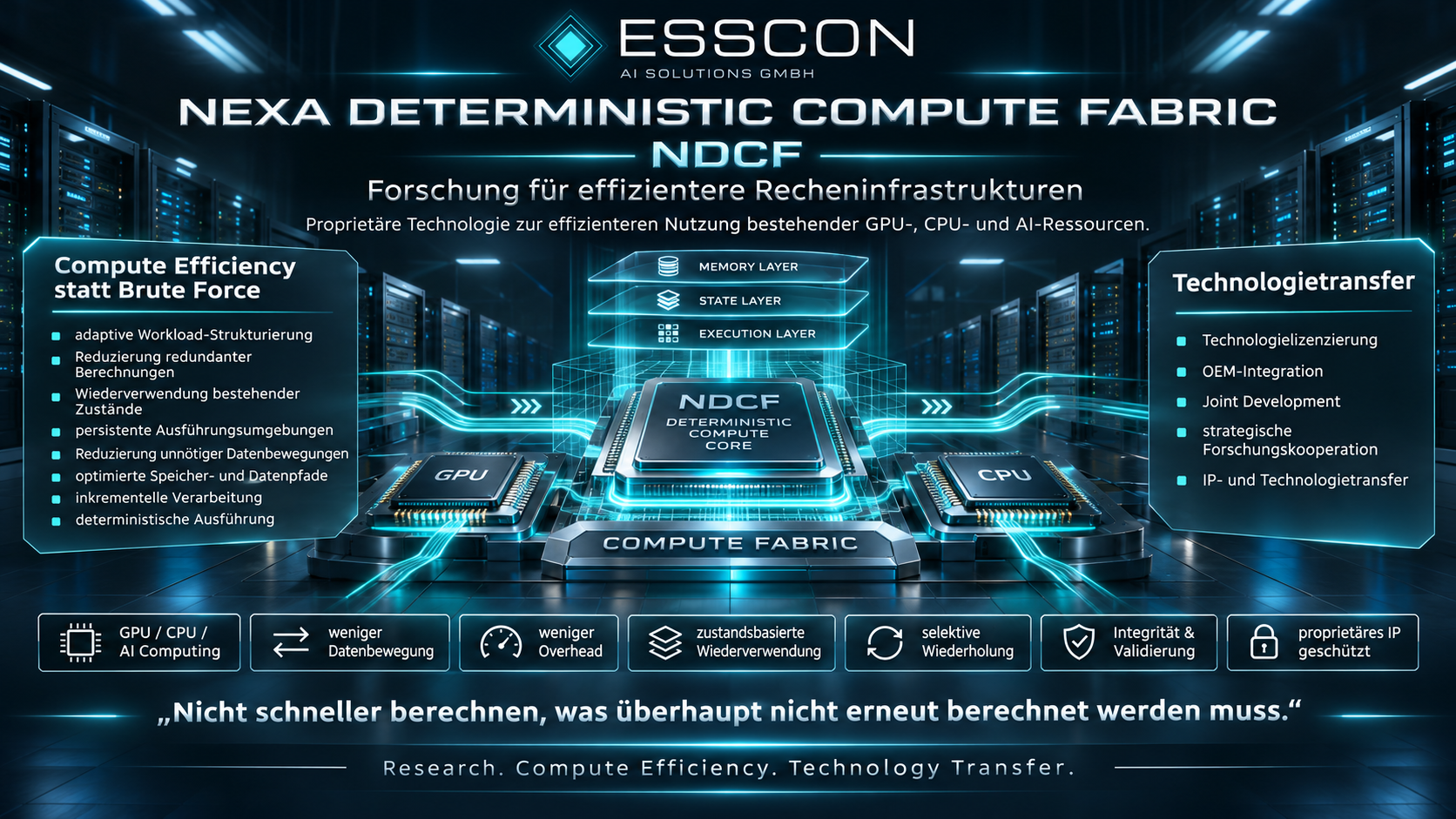
Proprietary compute-efficiency technology with a productized Integration Runtime and SDK for existing GPU, CPU, edge and AI computing environments.
NDCF is a proprietary compute-efficiency technology of ESSCON AI SOLUTIONS GMBH. Its aim is to increase the share of existing computing power that is actually used for necessary work — without discarding the value of existing hardware and software infrastructure.
With the NDCF Integration Runtime R1 and NDCF SDK 1.0, a productized integration layer is now available. Technology partners can connect NDCF to existing compute workloads in a controlled manner without requiring access to the protected core implementation.
“Deploy computing work where it is actually required.”
Compute efficiency instead of brute force: Before adding additional hardware, memory, or energy consumption, NDCF examines how much of the existing computing capacity can actually be made usable for the respective workload.
The current validation chain includes neutral-state, dependency, AI/matrix, memory-stress, and lossless-representation workloads. The values are qualified for the respective predefined test cases and form the basis for workload-specific evaluations.
Measured in demanding, neutral AI and matrix validation workloads with confirmed result equivalence.
Four million structured compute data records were substantially reduced and subsequently reconstructed byte-for-byte exactly.
Reproducible validation run under highly constrained GPU memory conditions while a large AI model remained resident.
The accepted validation runs confirm the required semantic or byte-for-byte result equivalence.
The technology has been transferred from internal research into a defined integration architecture. A defined runtime, SDK, and fallback architecture provides the basis for controlled customer and OEM integrations.
Productized integration layer for the controlled integration of NDCF into existing compute and AI environments.
Stable customer interface for workload registration, states, execution and verification records.
Gradual rollout from parallel validation to approved production operation.
The existing reference path remains available and can automatically take over in the event of deviations or runtime errors.
Executions can be traced through defined, cryptographically bound verification records.
Customer-specific workloads are requalified against the existing reference under controlled conditions.
NDCF can already be integrated into existing compute environments on a project-specific and individual basis. The architecture coordinates different workstations, servers, virtual machines, local clusters, and distributed enterprise and data-center environments.
NDCF complements existing applications, frameworks and compute infrastructure rather than requiring a complete platform change.
New integrations begin in Shadow mode. The existing production path initially remains the authoritative reference.
Performance, result equivalence and limitations are remeasured and documented for the partner’s specific workload.
The integration is designed to keep the original reference path available during qualification and operation.
Partners integrate through defined interfaces. The proprietary NDCF core technology remains within the controlled runtime.
Historical laboratory results serve as evidence of the technology. Customer-specific performance statements are derived from the frozen customer workload.
The NDCF roadmap is prepared for gradual expansion. Future compute nodes are intended to be capable of being integrated into a higher-level NDCF infrastructure independently of hardware generation, server role, or operating system.
ESSCON is developing an AI-assisted provisioning architecture for NDCF that is intended to automatically detect, verify, provision, and integrate new compute nodes into existing fabric structures. The goal is an infrastructure in which new systems can be integrated and made operational with minimal administrative effort.
New compute nodes are to be automatically classified by platform, role and technical environment.
The operating system, runtime prerequisites and integration conditions are to be checked before integration.
Suitable NDCF components are to be provisioned automatically for the respective compute node.
Node-specific configurations are to be generated, versioned and managed in a controlled manner.
Provisioned components and configurations are to be technically checked for completeness and integrity.
New systems are to be registered, versioned and technically validated before being added to the Fabric.
Deterministic Compute Infrastructure for heterogeneous systems.
NDCF is designed to enable the transition from individual optimized computer systems to coordinated, distributed compute infrastructures. The technology therefore addresses future application areas in high-performance computing, industrial computing platforms, enterprise data centers, AI infrastructures, research systems, edge computing, technical analysis platforms, and distributed CPU and compute architectures.
NDCF is evaluated based on result equivalence, reproducibility, and workload-specific performance qualification.
The test setup, comparison conditions and measurement parameters are defined before performance evaluation.
Accepted tests require defined result equivalence between the optimized and reference paths.
Validation series also include workloads with low or neutral efficiency potential, making the limits of applicability visible.
Accepted results are repeated, documented, and bound to stored verification records.
ESSCON operates NDCF as an independent proprietary technology. Collaborations may range from customer-specific integration and OEM licensing to exclusive strategic models. Scope, exclusivity, and IP rights are agreed individually.
NDCF can be made available for defined areas of application and platforms under strategic licensing models.
The Integration Runtime can be embedded into products or infrastructure platforms of qualified technology partners.
For selected markets, platforms, or strategic areas of application, exclusive rights may be subject to individual agreements.
Customer-specific compute-efficiency profiles can be jointly qualified for specific hardware and infrastructure environments.
Where strategically relevant, ESSCON also considers broader exclusivity, IP, and technology-transfer models.
Algorithms, internal execution procedures, development sources, and protected engine implementations remain the proprietary intellectual property of ESSCON AI SOLUTIONS GMBH.
Technology partners integrate through defined interfaces and receive the evidence required for their collaboration. Further technical documentation and customer-specific evaluations are provided within the agreed confidentiality framework.
The public brief summarizes product status, validated impact, Integration Runtime R1, SDK 1.0, technology transfer, and IP protection, and includes selected sanitized evidence excerpts — without complete internal validation logs or protected implementation details. Further technical evidence may be provided through a confidential NDCF evaluation to be agreed.
For compute and communication infrastructure, the main controls are identity, access rights, system hardening, operational continuity and traceable changes rather than generic AI policy alone. These controls are tied directly to technical operations.
Required standards and evidence depend on operating model, data class, customer environment and criticality. Integrations are scoped and documented accordingly.